AI is making formal verification of software practical
Originally published on Substack.
What happens in the world when AI agents make finding and exploiting security vulnerabilities much easier?
I wrote about the risks for banks recently [link] and how we’ll see a bigger shift toward formal verification in software similar to the LEAN style proofs in Mathematics (recent examples include the Navier-Stokes proof). Basically, mathematically proving that code can run without any flaws under a defined set of assumptions.
This is not something new and has been around for many years, but it was just too slow and laborious. However, the AI agents are now making it much more tractable and scaleable.
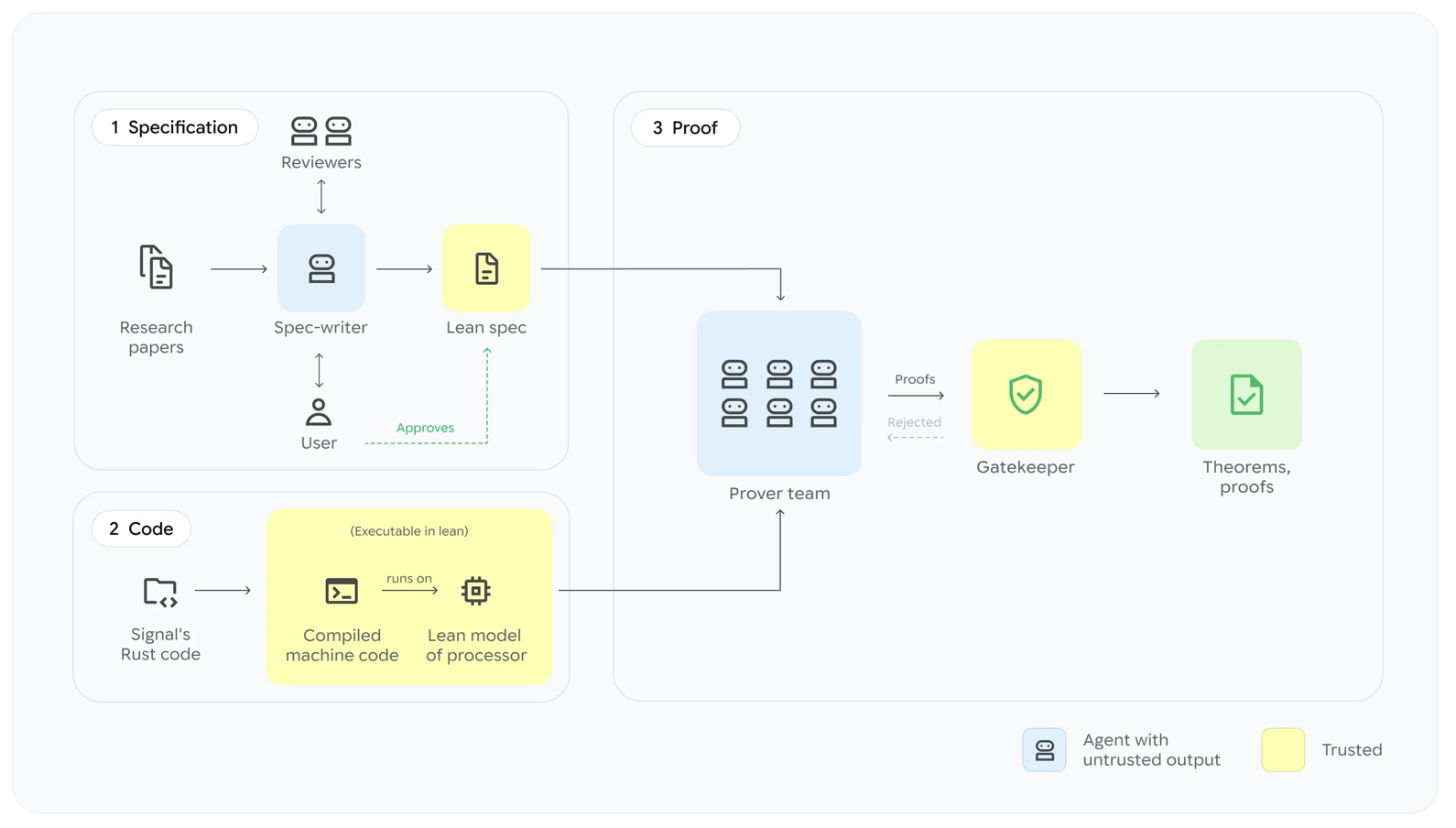
Today, Google DeepMind announced AlphaProof Code, their agentic verification framework. AI agents generated over six million lines of Lean proofs to verify key security properties of Signal’s cryptographic code.
This is a good indication of where we’re headed and I expect to see more and more of this style of formal verification for critical software in the coming days.
The same AI capabilities that make attacks easier could also make much stronger defenses.
→ Introducing AlphaProof Code: a breakthrough in verifying complex software at depth (deepmind.google)