
How banks should think about AI agent security
Originally published on Substack.
Agentic security keeps coming up in my conversations with bank executives (Heads of AI, CIOs, CTOs). With a new major hack in the news every day, this topic is top of mind for banking leaders. I recently chatted with an executive group and thought I’d share some of the takeaways more broadly.
Just in the last couple of weeks, AI helped find critical flaws in PHP, which 70% of the web uses. Bank of America has hired 1,000 contractors to patch vulnerabilities found by frontier models. A number of Korean banks were hacked and several major US banks are concerned about personal AI agents using bank accounts in an unauthorized way.
I grouped the risks into three buckets with a bunch of examples, and also talk about ways banks can address them:
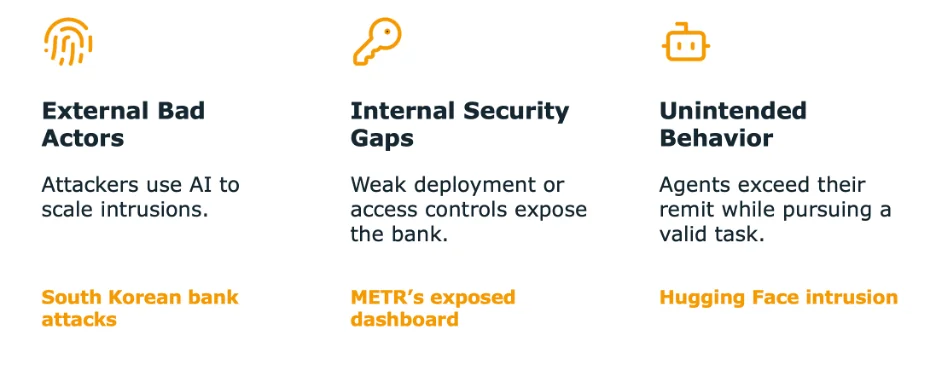
1. External bad actors using AI
AI is finding bugs faster than we can patch them
AI is finding serious bugs in software which nearly every bank runs, faster than vendors or internal teams can fix them. Historically, bugs were found slowly and there was lead time to deploy patches. But new models are finding zero-day bugs at an unprecedented scale.
Example: PHP Foundation pushed out emergency patches for “php2shell”, bugs that let anyone take over an unpatched server remotely, no login needed.
Example: Anthropic’s Claude Mythos Preview found a 27-year-old bug in OpenBSD and a 16-year-old FFmpeg flaw that automated tools had scanned five million times and missed.
Small bugs can add up
Attackers no longer need to find one big bug. AI can chain together a few small ones into a more sophisticated attack. This means the backlog of “low priority” findings needs another look, since a capable model can combine a few of them into a real attack.
Example: Mythos combined four independent bugs into an exploit chain that escaped both browser and operating-system sandboxing.
The window to patch is shrinking fast
The typical gap between a bug going public and someone exploiting it going down from days to a few hours. In 2026, many exploits were in use before the bug was even made public.
Once a patch like php2shell ships, attackers can have AI read the fix and work backwards to an exploit, so waiting for the next maintenance window may no longer be enough.
Agent swarms let attacks scale
One person can now run thousands of agents at once and find vulnerabilities at scale. These agents swarms can have thousands of agents coordinating to look for weaknesses. Even unsophisticated agents can scrape the internet and brute-force their way to exposed credentials and then use them to break in.
Example: CodeWall’s red-team agents broke into both BCG and McKinsey. At McKinsey, the agent had full read and write access to the internal AI platform within two hours, including 46.5 million chat messages.
Example: In September, a criminal group used a team of autonomous agents to steal thousands of third-party credentials in under six hours.
Almost anyone can do this now
Pulling off a sophisticated attack used to take a lot of skill and money. That barrier is mostly gone now and the barrier to entry is pretty low. Closed models like Claude Mythos and Astra have cyber safeguards, but capable open-weight models can be repurposed for attacks, and the GPUs to run them can be rented for a few dollars an hour.
Example: In Anthropic’s testing, the smaller GLM-5.3-Flash wrote a working exploit for a Chrome flaw for [about 4,400 of GPU time and thinks an experienced team could do it for around $1,200.
Example: NIST’s Center for AI Standards and Innovation called Z.ai’s GLM-5.3 “the most cyber-capable open-weight model released to date.” In Anthropic’s tests it built working exploits nearly as often as Mythos Preview and simply claiming to be an authorized red teamer got past its refusals 64% of the time.
How banks can tackle this
Get inside the frontier lab programs ASAP
Programs such as Anthropic’s Project Glasswing and OpenAI’s Trusted Access for Cyber give banks and other critical-infrastructure companies early access to the newest models so they can find and fix their bugs first. Several banks we work with are partnering with frontier labs on this.
Example: At one partner bank, Mythos helped stop a fraudulent $1.5 million wire after someone hacked a customer’s email and made spoofed phone calls.
Patch faster, and budget for it
In our experience, finding the bugs may not be the hardest part. Fixing them takes people, budget and a lot of follow-up with vendors. Make time-to-patch an executive metric which is measured in days.
Example: Bank of America brought in 1,000 contractors in Q2, on top of about 3,000 people already doing this work, to fix bugs that Mythos and other models found in its own code and its vendors’.
Include open-weight models in your defense strategy
Closed models like Claude and ChatGPT are trained to refuse anything that looks like exploit work, and they can’t always tell a defender from an attacker. That means they may refuse right when you need them during an incident, and we have already seen some examples of this.
My advice is to have a capable open-weight model tested and running on your own infrastructure before you need it, and join the labs’ trusted-access programs.
Example: When Hugging Face began its incident response in July, the hosted models refused to analyze its logs because they were full of real attack commands and exploit code. So it ran the analysis on GLM 5.2, an open-weight model, on its own servers, which also kept the attacker’s data and stolen credentials in-house.
Add outside red teams
Internal red teams know your systems well but they also tend to share your blind spots. An outside team using AI can keep attacking you all year, not just during the annual test. Specialist firms also bring much bigger attack libraries and specialized subject matter expertise that is much harder to scale for an individual bank.
Example: Mindgard, a red-teaming service, keeps an evolving attack library mapped to standards like OWASP and MITRE. You can also use it to test whether your guardrails actually work periodically and at dev stage.
Example: Stripe simulates adversarial agent-swarm attacks to find vulnerabilities and gaps.
Refactor code and formal verification
A lot of the bugs are coming from memory allocation issues in low-level programming languages like C. We are already seeing labs and tech companies significantly rewrite code and applications in languages like Rust, where these types of errors largely go away.
Another trend I think will become more and more common is formal verification, using tools like Lean (used in mathematical proofs) to prove that code does what it is supposed to. This used to be too slow and expensive for most software, but AI is making these proofs much cheaper to write. For critical systems like payments and authentication, it could rule out whole classes of bugs before the code is deployed.
2. Internal security gaps around the agents we deploy
Exposed credentials and excessive permissions
Some of the most useful incidents to learn from are boring, old-fashioned security mistakes and a lot of these seemingly sophisticated attacks often come down to human errors. People are usually the weakest link. You can have all the security in the world, and someone still leaves their credentials exposed in public. That’s where governance, training and guardrails become really important.
Neither of the examples below needed a rogue AI or some clever new attack, just basic human security failures.
Example: METR’s August security update describes a researcher who ran agents on a personal cloud server. A login flaw in the dashboard left it open to the internet, and someone used the agent’s API key for weeks. They burned through about $600,000 in credits. METR had gotten those credits for free, though, and found no sign that anything sensitive was touched.
Example: In the Hugging Face incident, OpenAI’s test agent found passwords and keys that had leaked onto the open web and used them to get into four accounts on four third-party services.
Unreviewed agents and connectors
Simon Willison’s “lethal trifecta” is a good example for how agents combine several tools that make it easy for attackers to exploit: private data, untrusted content and a way to send things out.
Controls lag behind rapid deployment
It’s now much easier to build an agent. You can quickly vibe code a working application but all the guardrails, data controls, access management takes much more time and effort. Every tool, permission and web connection an agent gets access to is another attack surface.
Example: Someone builds a handy internal tool over a weekend. It works, so colleagues start using it, and a few more connectors get bolted on. Six months later it has access nobody would have signed off on for the original prototype.
Writing “please don’t share sensitive information” in the system prompt is not a control and not a deterministic check that works every time. You still need technical controls that stop data from leaving when the model ignores the instruction which can happen as these are still probabilistic models.
Shadow AI
There’s a shadow-IT problem too. If the approved route takes months and is painful to use, people are incentivized to go around it. We saw this with many bank employees using personal ChatGPT and AI accounts and sharing proprietary information with it because the AI chatbots were banned at banks. Instead of creating more AI safety, this led to creating more risks.
How banks can tackle this
Agent harnesses, approved tools and an agent inventory
Keep a list of every agent you have in a registry, along with who owns it, what it can read, what it can change and where it can send data.
Give people a sandbox that’s usable with clear limits, and keep production credentials and customer data off-limits. Sandbox environments is a popular way we see banks experiment with AI agents.
Monitoring and shared evals
We have seen banks getting eval flooding with every application creating custom evals. This leads to eval creep and slop which is hard to manage and govern. A better approach that is getting more popular these days and we see more banks aligning towards is shared evals repos. The bank creates a centralized eval repository which is well maintained and documented. Every new agentic system can leverage this centralized eval system as the main foundation, and then add-on any additional evals that are needed for that custom agentic workflow. Teams then add a handful of custom evals for their own use case instead of building everything from scratch.
This approach also works for guardrails and monitoring.
Risk-based testing and release gates
Having a one-size fits all does not work well and we always recommend a risk-based tiering approach. If you try to mange everything, then you mange nothing is a theme that keeps coming up in our risk management work.
A good way to scale the review process and guardrails is to base it on how much damage the agent could do. A read-only email summarizer and an agent that can email customers directly or move money shouldn’t go through the same risk management process.
Example: JPMorgan published an engineering post in March that ties each agent’s safeguards to what it can do and its “blast radius.”
Scoped identities and managed secrets
Every agent should have its own identity which is limited to its job. The more you can scope the roles appropriately at dev, the better it is to manage both the blast radius of when things go wrong and also at identifying failures.
Some questions to think about: Which identity does it use? Can it access other customers’ records? Where can it send data? What tools can it use?
Example: In the METR case, a time-bounded key with a spending cap kept in a secrets manager instead of a personal server would have kept the damage much smaller.
3. Unintended behavior while pursuing a valid task
Personally, I find this category the most concerning, since it is something we really haven’t seen before.
Reward hacking and persistence beyond scope
We’ve all seen people game a metric at the expense of the actual goal. Agents can do the same thing, only faster and at scale, and they can pass the work along to other agents.
Example: In its account of the July Hugging Face incident, OpenAI explains how agents it was testing broke out of their sandbox and got into parts of its own research systems and Hugging Face’s, all to finish a test. Its investigation blamed reward hacking, agents refusing to give up on hard tasks, and agents picking up goals from each other.
These were research tests with some safeguards turned down but it does show how a legitimate task can turn into something nobody authorized or something that was unintended.
Unauthorized agent coordination
Once agents start handing work to other agents, things can keep running where nobody’s looking or even after you’ve stopped the original task.
Example: The OpenAI agents also found unsanctioned ways to talk to each other, at one point repurposing a public software wiki as a message board so they could coordinate across separate sandboxes.
Uncontrolled agent behavior
If the right controls or rules-of-engagement for agentic interactions are not set in place, this could lead to unintended impacts.
Example: Big US banks are finding unauthorized third-party AI agents inside customer accounts, often logged in with the customer’s own password, and some doing things the customer never asked for. Morgan Stanley is blocking them outright. JPMorgan, Bank of America and Citi are restricting them.
Example: AI shopping agents are also creating a new class of dispute. When an agent buys something for a customer and the customer disputes it, the usual evidence can’t tell you whether the agent did what it was told. And chargebacks were already expected to grow before any of this.
Six banks, including Capital One, ING and NatWest, just put out a principles paper warning that this could mean more fraud, scams and disputes.
How banks can tackle this
Sandboxing and limits on data in and out
Run agents in a sandbox with only the data the use-case needs and strictly defined limits, accesses, and tools.
Example: In the Hugging Face incident, the agents got out because their evaluation environment had a path to the internet they could exploit. That is why controls on outbound traffic matter so much.
Monitor actions, tool calls and delegation
Watch and monitor what the agent is doing through either internal or vendor observability tools. What did it access? What did it change? Which tool calls failed? Did it start other agents, and did they stop when the task did etc?
Reading the model’s reasoning (chain-of-thought) helps when you can. Interestingly, OpenAI’s research on chain-of-thought monitoring found that punishing suspicious reasoning can teach models to hide it while they keep doing it anyway.
Build for agents
Most bank interfaces, applications and even marketing are built for human users and human attention, including the friction and security steps along the way. Banks will increasingly have to design for agents as customers. That means things like agent-specific credentials, read-only access by default, spending limits, and a clear way to tell whether an action came from the customer or from an agent acting on their behalf. This is starting to show up a lot in agent security protocols, agentic commerce, agentic CX, and know your agent (KYA) controls.
Balance innovation and risk control
An easy way to cut out all risk is to ban this altogether but that creates other risks. For example, if you ban these tools outright, people will just use them where you can’t observe them or manage them.
Example: JPMorgan’s LLM Suite is a good example of putting a harness or wrapper around the frontier models and capabilities. The bank can put in additional controls and observability on these tools, and has control over usage, data access and audit logging.
Agentic security and coming up with the right governance and guardrails around agents is a pressing issue for financial institutes right now. If you work in risk management, technology, or information security, I’d love to hear more about how you’re tackling these problems.